01
Building the file
Missing pieces become a task for the customer. Payslips, identity documents, annual accounts and social contributions arrive structured instead of as scattered mail.
Adefin is not a form with a calculator behind it. It is the whole chain: query the sources, weigh the risk, collect the paperwork, compute the offers and keep the file honest all the way to delivery.
An enterprise number is enough to build the picture. What is public we fetch automatically; what is missing we request from the customer, precisely.
We connect to several business and credit information providers side by side, so you are not locked to one vendor and a source can be swapped without changing how you work. Every query is stored with its moment, so a decision stays traceable to what was known at the time.
The factors live in a catalogue, not in the code. Per factor you decide three things: how a value becomes a strength, how much it weighs, and whether it is a knock-out.
Next to the standard Adefin model, every financing partner can have their own. The same file then produces different outcomes, exactly as it does in reality.
Every file is worked through the way an analyst would: query the sources, read the documents that came in, pull the figures out and hold them against each other, and look up what there is to find about the company and its directors.
That does not produce a black box. Every finding carries its source, the time it was queried and the quote it rests on, so your analyst has nothing to believe and everything to check.
What comes out goes through the weighted model and through your knock-outs. The AI does not decide, and findings from the integrity check and from the research are never counted automatically.
The AI credit officer is not a pass-through to a public chat service. It runs on our own setup, with the model that fits for each task, and the files stay inside our environment within the European Union.
Every step it takes is logged like any other step in the file: which source, which model, which version, which time. An assessment from last year is still explainable three years from now.
And what it proposes always goes through the weighted model and past a person. Your files are not used to train models, for anyone.
The file stays one thing, from the first simulation to the delivery of the goods.
Missing pieces become a task for the customer. Payslips, identity documents, annual accounts and social contributions arrive structured instead of as scattered mail.
Per financing partner you set terms, residual values, first increased instalment and price windows. The maths is a classic annuity with a residual, ranked by monthly payment including VAT.
Request, offer, contract and delivery, with a signature tied to the version that was signed. Every transition is kept as an event.
The platform was built as a machine interface first and given a screen afterwards. What your people do in the console, your own system can do over the API.
Authentication with an API key per source, or a user token for partners. Webhooks signed with HMAC, so you know a notification really came from us.
POST /api/v1/applications
X-API-Key: …

{
  "applicant": { "vat": "BE0473773635" },
  "asset":     { "price_incl_vat": 38500, "term": 48 }
}

→ 201  { "ref": "APP-7F2K", "status": "received" }

POST /api/v1/applications/APP-7F2K/score
→ 200  { "score": 72, "tier": "B", "approved": true,
         "actions": [ { "add": "personal_guarantee", "gain": 8 } ] }
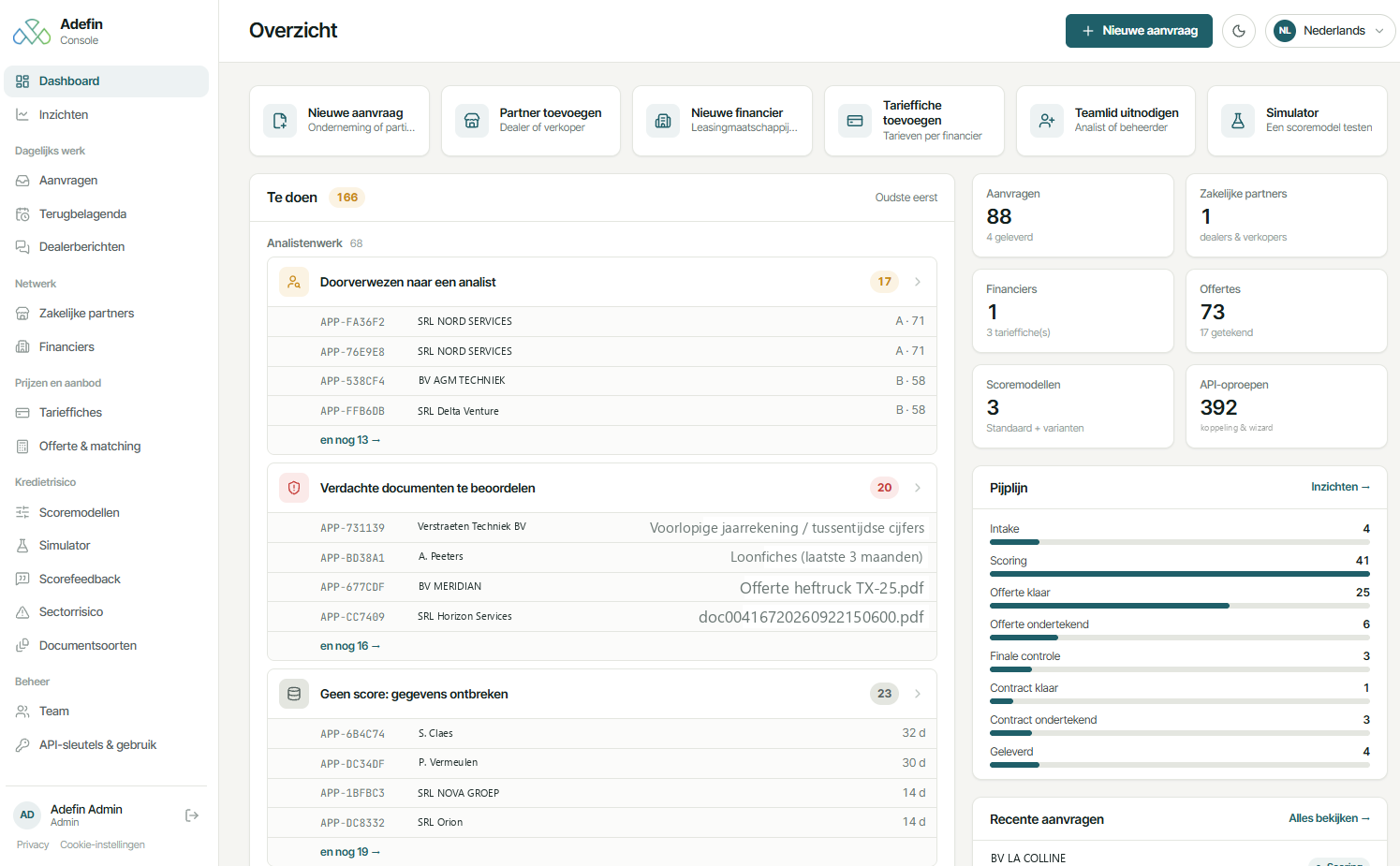
Today's work at the top: what has to go to an analyst, which documents need a judgement and which files are still missing data, with the pipeline and the latest applications beside it. Screenshots from the product. Names, numbers and amounts have been replaced.
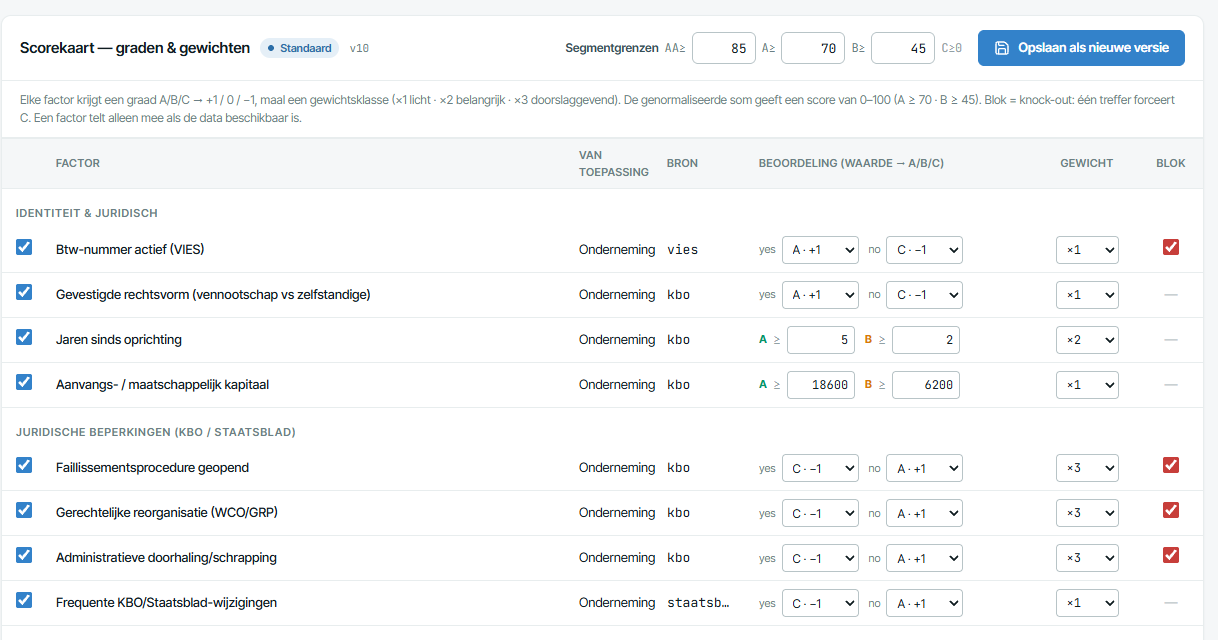
On the left you tune the model: a grade per factor, a weight, and whether it blocks.
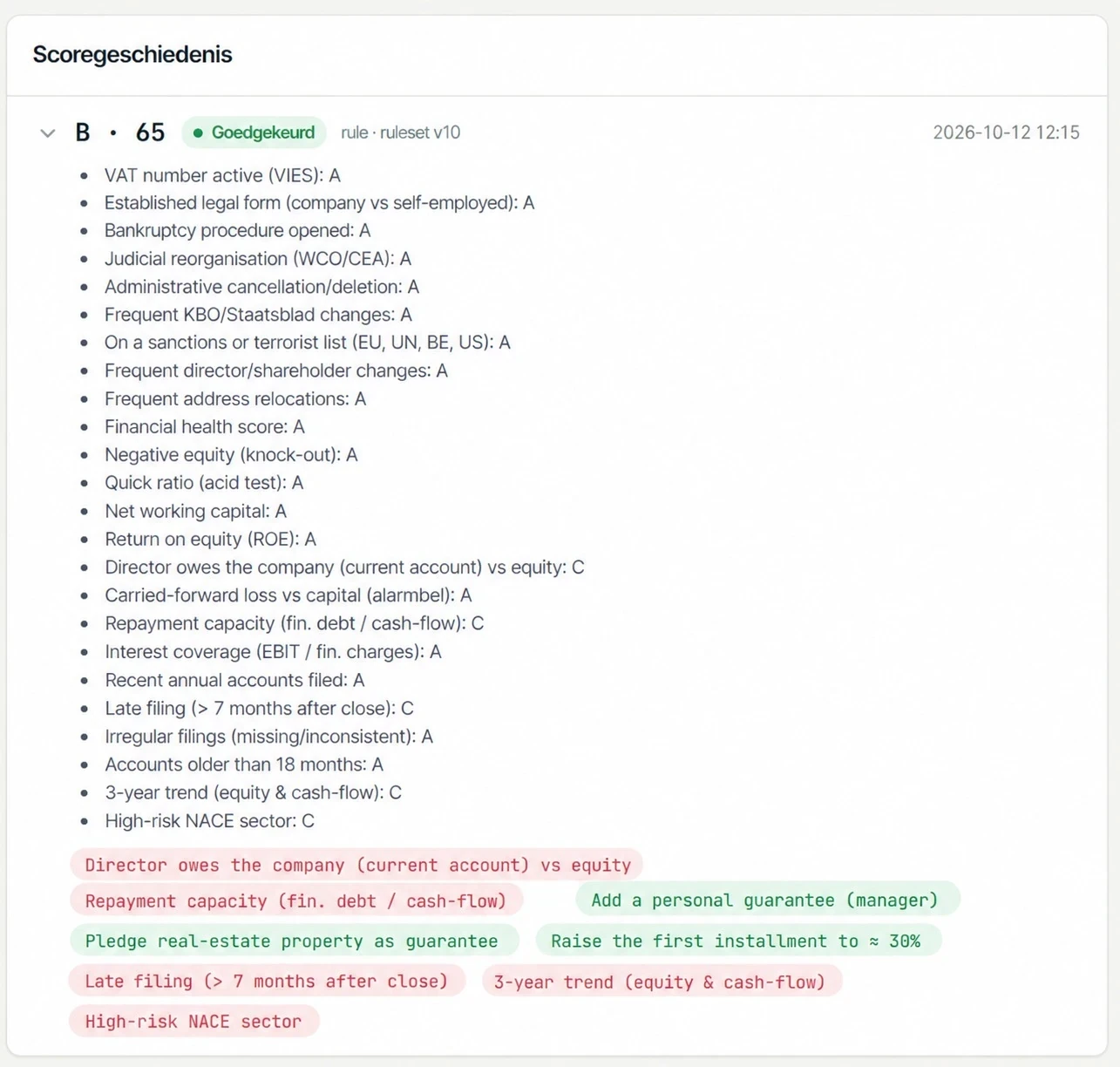
On the right the result on one file: every factor with its grade, and underneath what pulls the score down next to what dealing with it would be worth.
The groundwork: query the sources, read the documents that came in, pull the figures out, look up what is known about the company and its directors, and write the reasoning behind the file. Every finding carries its source, the time and the quote.
Weighing and deciding, it does not. That stays with the financing partner's score model and with their analyst.
No. Models propose, people decide. Findings from the integrity check and from the research are never scored automatically: they stay open for assessment, with their source attached.
That is what it is built for. Every source with the time it was queried, the version of the score model that produced the score, who changed which parameter and when, and every step as its own event with its time and its actor.
We take a request you know, and show which sources answer, what the score does and which offers come out.